Knee Arthroscopy in Bournemouth
Mr Paul Pavlou, a highly respected consultant knee surgeon in Bournemouth, provides advanced surgical solutions for a wide range of knee problems. He specialises in performing Knee Arthroscopy, a minimally invasive procedure designed to diagnose and treat knee joint issues with precision and care.
For patients in the Bournemouth area experiencing persistent knee pain, locking, or instability, this keyhole knee surgery offers a path to faster recovery and a swift return to daily activities. Mr Pavlou combines his extensive surgical expertise with a patient-focused approach, ensuring every individual receives a clear diagnosis and a personalised treatment plan tailored to their specific needs and lifestyle goals.
What is Knee Arthroscopy?
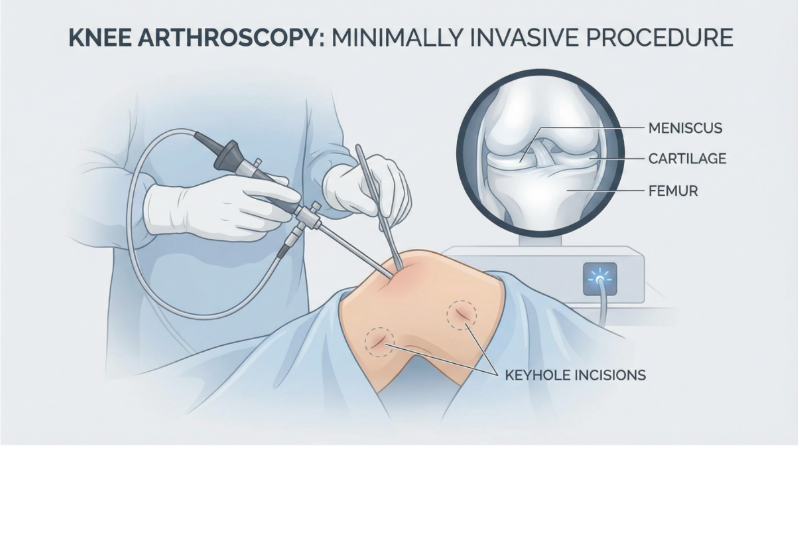
Knee arthroscopy, often referred to as keyhole surgery, is a modern surgical technique that allows a surgeon to see inside the knee joint without making a large incision. The procedure involves inserting an arthroscope—a thin, flexible tube equipped with a high-definition camera and a light source—through a very small cut in the skin.
This camera transmits live images to a video monitor, providing Mr Pavlou with a detailed, magnified view of the knee’s internal structures, including the cartilage, ligaments, and meniscus. This clear visualisation enables a precise diagnosis and allows for the treatment of various conditions using specialised, miniature surgical instruments inserted through other small incisions.
The minimally invasive nature of the procedure is its primary advantage, leading to significantly less post-operative pain and a quicker recovery compared to traditional open surgery.
Conditions Treated with Knee Arthroscopy
As a versatile diagnostic and therapeutic tool, knee arthroscopy is recommended for numerous conditions that cause pain and dysfunction, particularly when non-surgical treatments like physiotherapy and medication have not provided sufficient relief.
Mr Pavlou, a dedicated knee specialist, has extensive experience using arthroscopy to address these common issues.
| Condition | Description |
| Meniscal Tears | The meniscus is the C-shaped cartilage that acts as a shock absorber in the knee. Tears can cause pain, swelling, and locking. Arthroscopy can be used to either trim away the damaged portion (meniscectomy) or, in some cases, repair the tear. |
| Articular Cartilage Damage | The smooth, white cartilage covering the ends of the bones can become damaged through injury or wear. Arthroscopic procedures like chondroplasty can smooth the damaged surface to reduce friction and pain. |
| Ligament Injuries | While major ligament reconstructions (like for the ACL) are often more involved, arthroscopy is a key part of the procedure, allowing the surgeon to place the new ligament graft accurately. |
| Loose Bodies | Small fragments of bone or cartilage can break off and float within the joint, causing pain and mechanical symptoms like locking. These can be effectively located and removed during arthroscopy. |
| Synovitis or Plica Syndrome | The synovium is the soft lining of the knee joint. If it becomes inflamed (synovitis) or if a fold in the lining (a plica) becomes irritated, it can cause persistent pain. Arthroscopy allows for the removal of this inflamed tissue. |
The Knee Arthroscopy Procedure: What to Expect
Your journey begins with a comprehensive consultation at Mr Pavlou’s clinic in Bournemouth, where he will conduct a thorough physical examination and discuss your symptoms. An MRI scan is often arranged to provide detailed images of the knee’s internal structures, helping to confirm the diagnosis and plan the surgery.
Knee arthroscopy is typically performed as a day-case procedure, meaning you can go home the same day. It is usually carried out under general anaesthesia, although other options can be discussed. During the surgery, which often takes less than 30 minutes, Mr Pavlou will make two or three small incisions around the knee.
Through these portals, he will insert the arthroscope and surgical instruments to perform the necessary treatment. Afterwards, the small incisions are closed with stitches or adhesive strips and a bandage is applied. Mr Pavlou will explain the surgical findings to you before you leave the hospital.
Benefits of Arthroscopic Knee Surgery
The primary advantage of Knee Arthroscopy lies in its minimally invasive approach, which offers significant benefits compared to traditional open knee surgery. Patients who undergo this procedure typically experience:
- Less Post-Operative Pain: The small incisions cause minimal trauma to the surrounding soft tissues.
- Faster Recovery: Patients are often able to bear weight and move the knee much sooner.
- Reduced Scarring: The keyhole incisions result in very small, discreet scars.
- Lower Risk of Complications: The risk of infection and other surgical complications is generally lower.
- Quicker Return to Daily Life: Most patients can return to work, driving, and recreational activities more quickly.
Recovery and Rehabilitation
While recovery from knee arthroscopy is faster than with open surgery, a structured rehabilitation programme is vital for achieving the best possible outcome. Immediately after the procedure, you will be encouraged to rest with your leg elevated to manage swelling.
A physiotherapist will provide you with a set of exercises designed to restore your range of motion and strengthen the muscles supporting your knee, particularly the quadriceps and hamstrings. Most patients can walk without crutches, although they may be recommended for a short period depending on the specific procedure performed.
Adherence to the physiotherapy plan is crucial for a successful recovery, which typically sees patients returning to light activities within a few weeks and sports after four to six weeks.
Your Next Step
If you are suffering from persistent knee pain that is affecting your quality of life, Knee Arthroscopy may offer a definitive solution. A consultation with a specialist knee surgeon like Mr Paul Pavlou is the first step towards an accurate diagnosis and an effective treatment plan. To schedule an appointment at his practice in Bournemouth, please contact his office for more information.
This article provides general information and is not a substitute for professional medical advice. Individual results may vary, and it is essential to have a full consultation with a qualified healthcare professional to determine the best course of treatment for your specific condition.
The surgical procedure itself is usually very quick, typically lasting between 20 and 30 minutes. The exact duration will depend on the specific findings and the treatment required inside the knee.
You can typically resume driving once your knee is comfortable and you can perform an emergency stop without pain or hesitation. For many patients, this is possible within a week, but Mr Pavlou will provide personalised advice based on your procedure.
Most patients do not require crutches after a simple arthroscopy. However, they may be recommended for a few days for comfort or if a more complex procedure, such as a meniscal repair, was performed to protect the healing tissue.
Full recovery varies depending on the underlying problem and the surgery performed. Many patients feel significantly better within a few weeks, but it can take four to six weeks to return to most activities, including sports, with continued improvement over several months.
The surgery is performed under anaesthesia, so you will not feel any pain during the procedure. Post-operative discomfort is expected but is generally mild and can be well-managed with simple pain relief medication and by following the post-operative instructions for rest and ice.
References
[1] American Academy of Orthopaedic Surgeons. (n.d.). Knee Arthroscopy. OrthoInfo.