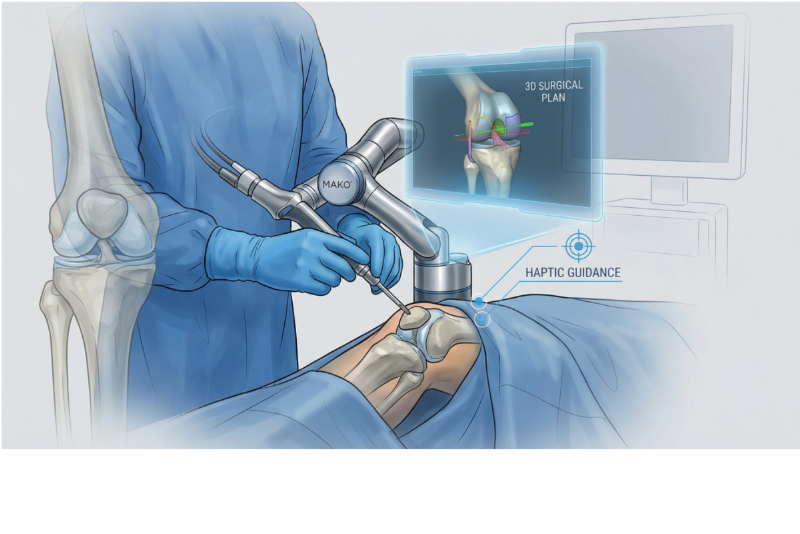
Mako® Robotic Arm Assisted Knee Replacement in Bournemouth
Mr Paul Pavlou, a distinguished consultant knee surgeon in Bournemouth, is at the forefront of orthopaedic innovation, offering patients advanced surgical solutions for knee arthritis. As a pioneer on the South Coast, he was the first surgeon to perform Mako® Robotic Arm Assisted Knee Replacement, a revolutionary procedure that enhances precision and improves outcomes.
For patients suffering from debilitating knee pain, this state-of-the-art knee surgery represents a significant leap forward. Mr Pavlou combines his extensive surgical skill with the unparalleled accuracy of Mako® technology to restore mobility, reduce pain, and help patients in the Bournemouth area return to an active lifestyle with confidence.
What is Mako® Robotic Arm Assisted Knee Replacement?
Mako® Robotic Arm Assisted Knee Replacement is an advanced surgical procedure for patients with severe knee arthritis. It utilises a sophisticated, surgeon-controlled robotic arm to perform knee replacement with a level of accuracy that is not possible with conventional manual techniques.
The system does not perform the surgery independently; rather, it is a highly advanced tool that assists the surgeon. Mr Pavlou remains in complete control throughout the procedure, using the robotic arm to execute a personalised surgical plan with exceptional precision. This technology allows for the optimal placement of the knee implant, which is critical for the function, feel, and longevity of the new joint.
How Does Mako® Technology Work?
The Mako® system integrates three key components to deliver a personalised surgical experience: 3D CT-based planning, AccuStop™ haptic technology, and data analytics.
- Personalised 3D Planning
The process begins with a CT scan of the patient’s knee, which is used to generate a precise 3D virtual model of their unique anatomy. This model allows Mr Pavlou to create a detailed, individualised pre-operative plan, determining the ideal size, placement, and alignment of the implant before the surgery even begins.
- Dynamic Joint Balancing
During the procedure, the system provides real-time data, allowing Mr Pavlou to assess the movement and tension of the soft tissues and ligaments in the knee. This enables him to fine-tune the implant’s position to achieve a stable, well-balanced knee joint through a full range of motion.
- Haptic-Guided Precision
The robotic arm provides tactile (haptic) feedback, creating a virtual boundary that helps the surgeon stay within the pre-defined surgical plan. This AccuStop™ technology ensures that only the diseased bone is removed, preserving the surrounding healthy bone and soft tissues.
The Benefits of Mako® Robotic Knee Replacement
As a leading knee specialist in Bournemouth, Mr Pavlou offers the Mako® procedure because of its significant, evidence-based advantages over traditional knee replacement surgery.
| Benefit | Mako® Robotic-Assisted Surgery | Traditional Manual Surgery |
| Implant Placement | Achieves superior accuracy and alignment based on a 3D plan. | Relies on manual guides and the surgeon’s visual estimation. |
| Bone Preservation | Haptic guidance ensures only the necessary bone is removed. | Greater potential for removal of healthy bone. |
| Soft Tissue Protection | The robotic boundary helps protect surrounding ligaments and tissues. | Higher risk of inadvertent soft tissue damage. |
| Recovery | Associated with less post-operative pain and a faster initial recovery. | Often involves more pain and a longer early recovery period. |
| Implant Longevity | More accurate placement is linked to improved long-term implant survival. | Implant lifespan can be affected by minor inaccuracies in placement. |
Clinical studies have shown that Mako® knee replacements are associated with less pain, a reduced need for opioid pain medication, and a quicker return to function in the early post-operative period.
Who is a Candidate for Mako® Knee Replacement?
Mako® Robotic Arm Assisted Knee Replacement is an excellent option for many patients suffering from knee pain due to osteoarthritis, rheumatoid arthritis, or post-traumatic arthritis. Ideal candidates are those who have not found relief from non-surgical treatments such as physiotherapy, medication, and injections.
Mr Pavlou will conduct a comprehensive assessment to determine if this advanced surgical option is the right choice. Factors such as the patient’s age, activity level, and the specific pattern of arthritis are all taken into consideration to ensure the best possible outcome.
The Mako® Procedure: What to Expect
The patient journey begins with a detailed consultation and the pre-operative CT scan. On the day of the surgery, Mr Pavlou will use the 3D model to guide the Mako® robotic arm. He will make the necessary bone preparations with unparalleled precision, ensuring the knee implant is positioned exactly according to the personalised plan.
The surgeon-controlled robotic arm provides a stable platform and haptic feedback, enhancing Mr Pavlou’s skill and control. After the implants are securely in place, the knee is balanced and the incisions are closed. The procedure is designed to be as minimally invasive as possible, contributing to a smoother recovery.
Your Next Step
If chronic knee pain is limiting your life, Mako® Robotic Arm Assisted Knee Replacement could be the solution you need. As a pioneer of this technology in the Bournemouth region, Mr Paul Pavlou offers unparalleled expertise in this field. To learn more and to schedule a consultation to see if you are a candidate, please contact his practice today.
No, absolutely not. The Mako® system is a tool that is fully controlled by the surgeon. Mr Pavlou performs the surgery, using the robotic arm to enhance the precision and accuracy of the procedure based on the personalised plan.
While the focus of Mako® is on the accuracy of bone preparation and implant placement, the technique is performed with a minimally invasive approach that is often associated with smaller incisions compared to some traditional methods.
The longevity of any knee implant depends on several factors, including the patient's activity level. However, studies suggest that the high degree of accuracy achieved with Mako® surgery contributes to better implant survival and longevity over the long term.
Recovery is often faster in the initial weeks following a Mako® knee replacement. Patients typically experience less pain and are able to begin physiotherapy sooner. Most patients are walking within hours of the surgery and can return to light activities within a few weeks.
While Mako® technology is designed to improve accuracy and outcomes, no surgery can guarantee a specific result. However, clinical evidence strongly supports the benefits of robotic assistance in achieving a more precisely placed implant and a well-balanced knee, which are critical factors for a successful knee replacement.