ACL Reconstruction in Bournemouth
Mr Paul Pavlou, a leading consultant knee surgeon in Bournemouth, specialises in the diagnosis and treatment of complex knee injuries, including tears of the Anterior Cruciate Ligament (ACL). For active individuals who have suffered this common yet significant injury, ACL Reconstruction surgery offers a reliable path back to stability, function, and sport.
Mr Pavlou combines advanced, minimally invasive surgical techniques with a patient-centred approach, ensuring that every patient in the Bournemouth area receives a comprehensive assessment and a personalised treatment plan. As a dedicated knee specialist, his goal is to restore knee function and help patients confidently return to the activities they love.
Understanding the ACL and ACL Injuries
The Anterior Cruciate Ligament (ACL) is one of the most important ligaments inside the knee joint. It runs diagonally through the middle of the knee, connecting the thighbone (femur) to the shinbone (tibia). Its primary role is to prevent the tibia from sliding too far forward and to provide rotational stability to the knee.
An ACL tear is a common injury, particularly in sports that involve sudden stops, pivoting, or changes in direction, such as football, rugby, tennis, and skiing. The injury often occurs without direct contact and is typically accompanied by a ‘popping’ sound, immediate pain, and significant swelling. An unstable knee that gives way during movement is a hallmark sign of a complete ACL rupture.
When is ACL Reconstruction Surgery Needed?
The decision to proceed with ACL Reconstruction is a significant one and is not necessary for every patient with an ACL tear. The choice depends on several factors, including the patient’s age, activity level, and the degree of knee instability. Mr Pavlou will conduct a thorough evaluation, including a physical examination and an MRI scan, to determine the best course of action.
Surgery is often recommended for:
- Active Individuals and Athletes: Those who wish to return to sports involving cutting, pivoting, or jumping movements.
- Patients with Knee Instability: If the knee frequently gives way during normal daily activities, surgery is often needed to restore stability and prevent further damage to other structures in the knee, such as the meniscus or articular cartilage.
- Combined Injuries: When the ACL tear occurs alongside other injuries, such as a meniscal tear, surgery is typically required to address all issues simultaneously.
For less active individuals or those whose knees do not feel unstable, a non-surgical approach involving physiotherapy and bracing may be a suitable alternative.
The ACL Reconstruction Procedure
ACL reconstruction is a highly successful and commonly performed knee surgery. The procedure is performed arthroscopically, using a minimally invasive ‘keyhole’ technique. Mr Pavlou will make small incisions around the knee to insert a camera (arthroscope) and specialised surgical instruments.
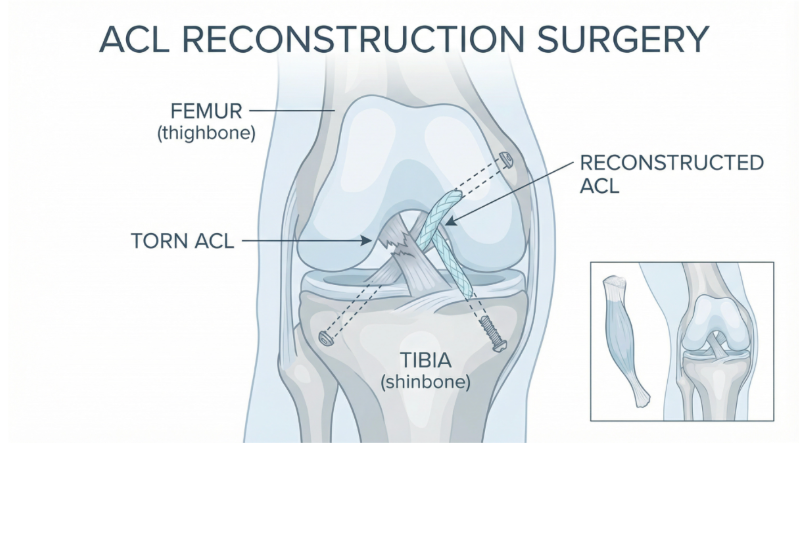
Since a torn ACL cannot be simply stitched back together, the procedure involves removing the damaged ligament and replacing it with a new one made from a tissue graft. This graft is passed through tunnels drilled into the femur and tibia and then securely fixed in place. The entire procedure is typically performed as a day case, allowing patients to return home the same day.
Graft Options for ACL Reconstruction
The choice of graft is a crucial part of the surgical planning, and Mr Pavlou will discuss the most suitable option with you. The most common graft choices are:
| Graft Type | Description |
| Hamstring Tendon Autograft | This is the most common choice. Two of the hamstring tendons are harvested from the patient’s own leg through a small incision. They are then folded to create a strong, multi-stranded graft. |
| Patellar Tendon Autograft | This graft is taken from the central third of the patient’s patellar tendon, along with small bone blocks from the kneecap and shinbone. It is a very strong graft, often preferred for high-demand athletes. |
| Quadriceps Tendon Autograft | A portion of the quadriceps tendon from the front of the thigh is used. This is another strong option with reliable outcomes. |
| Allograft | This is tissue taken from a deceased donor. It avoids the need to harvest tissue from the patient’s own body but is generally reserved for specific cases, as it can have a slightly higher failure rate in young, active patients. |
Recovery and Return to Sport
Recovery from ACL Reconstruction is a gradual process that requires commitment to a structured rehabilitation programme. The goal is to restore range of motion, strength, and stability to the knee. While the timeline can vary, a typical recovery follows several phases:
- Phase 1 (0-2 Weeks): The initial focus is on reducing pain and swelling, protecting the new graft, and gently regaining knee extension.
- Phase 2 (2-12 Weeks): The emphasis shifts to restoring full range of motion and progressively building strength in the quadriceps and hamstrings.
- Phase 3 (3-6 Months): More advanced strengthening exercises are introduced, and patients may begin a gradual return to running.
- Phase 4 (6-12 Months): This phase involves sport-specific drills, including jumping and cutting movements, to prepare for a safe return to play. Most athletes can expect to return to their sport between 9 and 12 months after surgery.
Your Next Step
If you have sustained a knee injury and are concerned about an ACL tear, a specialist consultation is the most important step towards recovery. Mr Paul Pavlou offers expert assessment and treatment for ACL injuries in the Bournemouth area. To schedule an appointment and discuss your options, please contact his practice.
ACL reconstruction is a very successful procedure, with studies showing that over 80% of athletes are able to return to some level of sport. The key to a successful outcome is a well-performed surgery followed by a dedicated rehabilitation programme.
Most patients use crutches for the first one to two weeks to help protect the knee and the new graft as it begins to heal. Mr Pavlou will provide specific instructions based on your individual procedure.
This depends on the nature of your job. If you have a desk-based job, you may be able to return to work within one to two weeks. For more physically demanding roles, it may take several weeks to a few months.
Some pain and discomfort are expected after any surgery, but this will be well-managed with a personalised pain relief plan. The initial post-operative pain typically subsides significantly within the first week.
Yes, while the reconstructed ligament is very strong, it is possible to re-injure it. The risk of re-tear is highest in the first year after surgery. Adhering to the rehabilitation protocol and ensuring a safe, gradual return to sport are the best ways to minimise this risk.