Shockwave Therapy in Bournemouth
Mr Paul Pavlou, a distinguished consultant knee surgeon based in Bournemouth, is dedicated to offering advanced and effective treatments for a wide range of knee conditions. For patients struggling with chronic knee pain that has not responded to traditional therapies, Mr Pavlou provides Extracorporeal Shockwave Therapy (ESWT).
This innovative, non-invasive treatment offers a powerful solution for stimulating the body’s natural healing processes, providing pain relief and restoring function without the need for surgery. As a leading knee specialist, Mr Pavlou uses evidence-based approaches to ensure each patient receives a tailored treatment plan designed to achieve the best possible long-term outcomes.
What is Extracorporeal Shockwave Therapy (ESWT)?
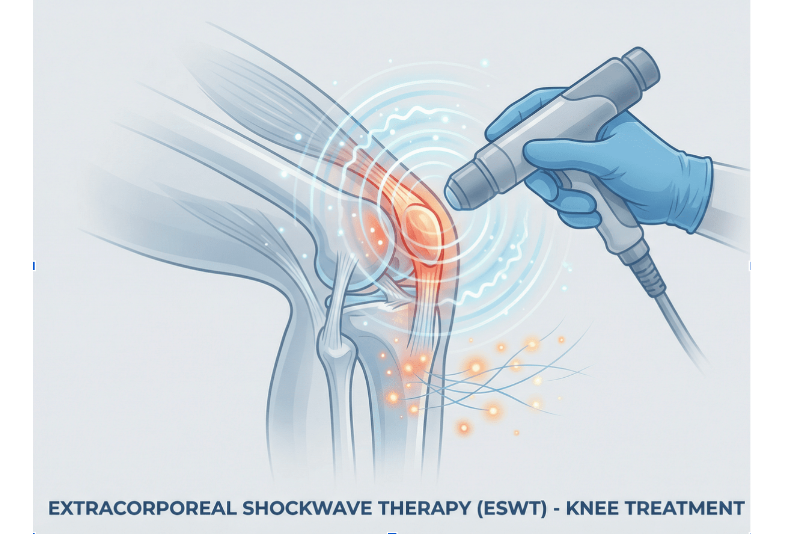
Extracorporeal Shockwave Therapy, commonly known as shockwave therapy, is a modern and highly effective non-surgical treatment for persistent musculoskeletal pain. The therapy uses a specialised device to deliver high-energy acoustic waves, or shockwaves, to the specific area of injury or pain.
These waves penetrate the skin and travel through the tissue to the targeted area, initiating a healing response within the body. It is a well-established modality, particularly for chronic tendinopathies and other conditions that have proven difficult to resolve with rest, physiotherapy, or medication alone. The treatment is performed in an outpatient setting and does not require anaesthesia, making it a convenient and low-risk option for many patients.
How Does Shockwave Therapy Work?
The therapeutic effects of shockwave therapy are driven by a process called mechanotransduction, where the focused acoustic waves create a controlled mechanical force on the tissue. This stimulus triggers a cascade of biological responses at a cellular level, essentially kick-starting a stalled healing process.
The key mechanisms include:
- Stimulation of Tissue Healing: The shockwaves create micro-trauma in the affected tissue, which prompts the body to increase metabolic activity around the site of pain. This accelerates the repair of damaged cells and enhances the production of collagen, a vital protein for the integrity of tendons and ligaments.
- Formation of New Blood Vessels (Neovascularization): The therapy stimulates the growth of new blood vessels. An improved blood supply brings more oxygen and nutrients to the injured area, which is crucial for effective and sustained tissue regeneration.
- Pain Reduction: The acoustic waves provide immediate pain relief by over-stimulating the nerve endings that send pain signals to the brain. This can disrupt the pain cycle and provide both short-term and long-term analgesic effects.
- Reduction of Chronic Inflammation: Shockwave therapy can help to modulate the inflammatory response, shifting it from a chronic, non-healing state to an acute, healing phase. This helps to resolve inflammation and reduce associated pain.
Knee Conditions Treated with Shockwave Therapy
As a specialist knee surgeon, Mr Paul Pavlou recommends shockwave therapy for a variety of knee-related conditions where chronic pain is a primary symptom. It is particularly effective for issues involving tendons and their attachment to the bone.
Common conditions treated include:
| Patellar Tendinopathy (Jumper’s Knee) | A common overuse injury causing pain in the tendon that connects the kneecap (patella) to the shinbone (tibia). ESWT is highly effective for this condition. |
| Osgood-Schlatter Disease | A condition often seen in active adolescents, causing a painful lump below the kneecap. Shockwave therapy can help manage pain and accelerate recovery. |
| Iliotibial (IT) Band Syndrome | Pain on the outside of the knee caused by friction of the IT band. Shockwave therapy can help to release tension and reduce inflammation. |
| Trochanteric Bursitis | While primarily a hip condition, the associated pain can often be felt around the knee. ESWT can effectively treat the source of the inflammation. |
| Early-Stage Knee Osteoarthritis | In some cases, shockwave therapy may help to reduce pain and improve function in patients with mild knee osteoarthritis. |
The Benefits of Choosing Shockwave Therapy
Shockwave therapy offers several significant advantages over more invasive treatments, making it an excellent first-line option for many chronic knee conditions. Mr Pavlou may recommend it as part of a comprehensive treatment plan.
- Non-Invasive: The procedure is performed entirely outside the body, with no need for incisions, needles, or anaesthesia.
- Minimal Side Effects: The most common side effects are minor and temporary, such as mild redness, swelling, or soreness at the treatment site.
- Fast Treatment Sessions: Each session typically lasts only 10 to 15 minutes.
- No Downtime: Patients can return to most of their normal daily activities immediately after treatment.
- Evidence-Based: Extensive clinical research has demonstrated success rates of 60-80% for many common musculoskeletal conditions, including those affecting the knee.
- Avoids Surgery: In many cases, successful treatment with shockwave therapy can eliminate the need for more invasive procedures like knee surgery.
What to Expect During Your Treatment
Your journey with shockwave therapy begins with a thorough consultation with Mr Paul Pavlou in his Bournemouth clinic. He will perform a physical examination and review your medical history to confirm that you are a suitable candidate.
Once a diagnosis is confirmed, the treatment process is straightforward. A gel is applied to the skin over the painful area to help transmit the acoustic waves effectively. Mr Pavlou will then use a handheld applicator to deliver the shockwaves to the precise location of your injury. While some patients experience mild discomfort during the application, the intensity can be adjusted for comfort. A typical course of treatment involves three sessions, scheduled approximately one week apart.
Your Next Step
If you are living with persistent knee pain and are looking for a non-surgical solution, Shockwave Therapy may be the answer. A specialist assessment with Mr Paul Pavlou will determine if this advanced treatment is right for you. To schedule a consultation at his practice in Bournemouth, please contact his office to arrange an appointment.
This article is for general information only and does not constitute medical advice. Treatment outcomes can vary, and a full consultation with a qualified specialist is required to determine the most appropriate course of action for your individual circumstances.
FAQs
Some patients report mild discomfort during the 10-15 minute session, but the intensity can be adjusted. Most people find the treatment tolerable, and any soreness afterwards is usually temporary and resolves within a day or two.
A standard course of treatment is typically three sessions, spaced one week apart. However, Mr Pavlou will create a personalised plan based on your specific condition and your response to the therapy.
Many patients experience some pain relief within 24 hours of their first session. However, the full benefits emerge over time as the body’s healing process continues. Optimal results are typically seen a few weeks after the final treatment session.
Ideal candidates are typically individuals with chronic tendon-related knee pain (lasting more than three months) who have not found relief with conservative treatments like rest, ice, and physiotherapy. Mr Pavlou will conduct a full assessment to confirm suitability.
Yes, you can generally continue with your normal daily activities. However, it is often recommended to avoid high-impact exercise or strenuous activities involving the treated area for 48 hours after each session to allow the healing process to begin.